
In today’s fast-changing market — where customer behaviors shift overnight and new competitors appear constantly — relying solely on traditional marketing is no longer enough. Growth Hacking, a term coined by Sean Ellis, is a data-driven, experiment-oriented, and cross-functional approach designed to help small and medium-sized businesses (SMBs) achieve high-impact growth with minimal costs.
More than just a set of marketing tactics, growth hacking is a mindset and process that turns small experiments into scalable success. Whether you run a café, a consultancy, or a digital startup, adopting growth hacking principles helps you uncover what truly drives your customers to buy, stay, and share your brand.
What Exactly Is Growth Hacking?
Growth Hacking is all about finding the smartest, most efficient ways to grow a business through continuous experimentation across marketing, product, and customer experience.
As Sean Ellis explains in his book Hacking Growth, it’s a process of rapid testing and learning — trying out new ideas, analyzing the results with data, and quickly doubling down on what works. Instead of depending on huge ad budgets or gut instincts, growth hacking blends creativity, analytics, and collaboration to uncover scalable growth opportunities.
The beauty of this approach is its focus on measurable results. Growth hackers don’t chase vanity metrics like likes or page views — they care about the entire customer journey, from how people discover your brand, to why they stay, buy again, and refer others.
💡 Example:
Imagine a local café testing two versions of a loyalty email to see which one brings more repeat customers, or experimenting with different social media posts to find what drives more in-store purchases. These small, data-backed experiments — and the willingness to learn fast — are the heart of growth hacking.
The “Aha Moment” — The Foundation of Growth
Before any growth hacking tactics can succeed, there’s one non-negotiable foundation: product/market fit — what Sean Ellis calls the “aha moment.”
This “aha moment” happens when users truly experience the core value of your product or service — when it becomes something they can’t imagine losing. It’s the emotional and functional connection that turns casual users into loyal advocates.
Ellis emphasizes that sustainable, rapid growth only happens after a business reaches this must-have stage.If your customers wouldn’t be deeply disappointed if they could no longer use your product, your focus shouldn’t be on growth hacking yet — it should be on finding product/market fit.
In other words, growth hacking doesn’t create demand; it amplifies satisfaction. Once you’ve discovered your “aha moment,” growth hacking becomes the engine that scales it efficiently.
💡 Example:
Dropbox’s “aha moment” came when users realized they could access their files seamlessly across devices — and the referral program that followed simply amplified that must-have value. For a small café, it might be when customers taste your signature pastry and immediately want to bring their friends next time.
Why Growth Hacking Isn’t Just for Tech Companies
Although Growth Hacking was born in Silicon Valley — used by startups like Dropbox, Airbnb, and Uber to achieve rapid growth with limited resources — its creator, Sean Ellis, emphasizes that this approach is not just for software companies.It can be applied to any business that wants to grow smarter and more efficiently.
Today’s environment actually makes growth hacking ideal for SMBs, for three key reasons:
- Data tools are widely accessible
Tools like Google Analytics, POS systems, and CRM software let you track customer behavior, preferences, and repeat visits. - Customer journeys are increasingly digital
Customers discover your business through Instagram, Google Maps, and online reviews. Even small digital experiments can significantly impact sales. - SMBs are more agile
Unlike large corporations with long decision chains, small businesses can quickly test, adjust, and implement changes — the exact kind of flexibility growth hacking requires.
💡 Example:
A local bakery could experiment with different loyalty programs, test which social posts drive the most in-store traffic, or use email A/B testing to find messages that boost repeat purchases. These seemingly small actions are all part of growth hacking — using small, data-driven experiments to generate measurable business growth.
Growth Hacking vs. Traditional Business Functions
In traditional businesses, teams often work in silos:
- Marketing focuses on promotion.
- Product develops what’s sold.
- Sales closes deals.
- Customer support handles post-purchase issues.
This separation limits the flow of insights and stifles growth potential.
Growth hacking breaks these barriers, aligning marketing, product, sales, and customer success around one shared goal: sustainable, scalable growth.
🔄 The AARRR Funnel:
- Acquisition – Attract potential customers.
- Activation – Deliver a great first experience.
- Retention – Keep users engaged over time.
- Referral – Encourage satisfied customers to share.
- Revenue – Convert engagement into income.
💡 Example:
Marketing tests lead-generation ads → Product improves onboarding to activate users faster → Customer success introduces referral rewards.
By sharing data and aligning goals, teams create a continuous cycle of experimentation and optimization — the engine of growth.
How SMEs Can Benefit from Growth Hacking
SMEs often face tight budgets and limited manpower, making traditional marketing methods—billboards, TV ads, or big agency campaigns—expensive and inefficient. Growth hacking offers a smarter, lower-cost alternative that focuses on adaptability, measurable results, and learning.
Here’s how SMEs can apply it:
- Start with Data, Not Assumptions
Use Google Analytics, Clarity, or PostHog to understand your audience. Identify where users drop off and why. - Run Small, Measurable Tests
Experiment with email subject lines, ad creatives, or landing page headlines. Measure results and double down on what converts. - Align Around a North Star Metric
Pick one key growth metric — like repeat purchase rate or signup rate — and let it guide every decision. - Learn Fast, Scale What Works
Don’t chase perfection; chase progress. Failed experiments still provide insight that saves future effort and cost.
💡 Example:
A local café might test loyalty email designs, promotion messages, or posting schedules. Each experiment produces valuable data to refine strategy and maximize return — without overspending.
From Hacking Growth to Lean Analytics: Building a Smarter Business Model
While Hacking Growth teaches you how to experiment for growth, Lean Analytics by Alistair Croll shows you how to measure what truly matters. Growth isn’t about testing everything — it’s about knowing which experiments actually move the needle.
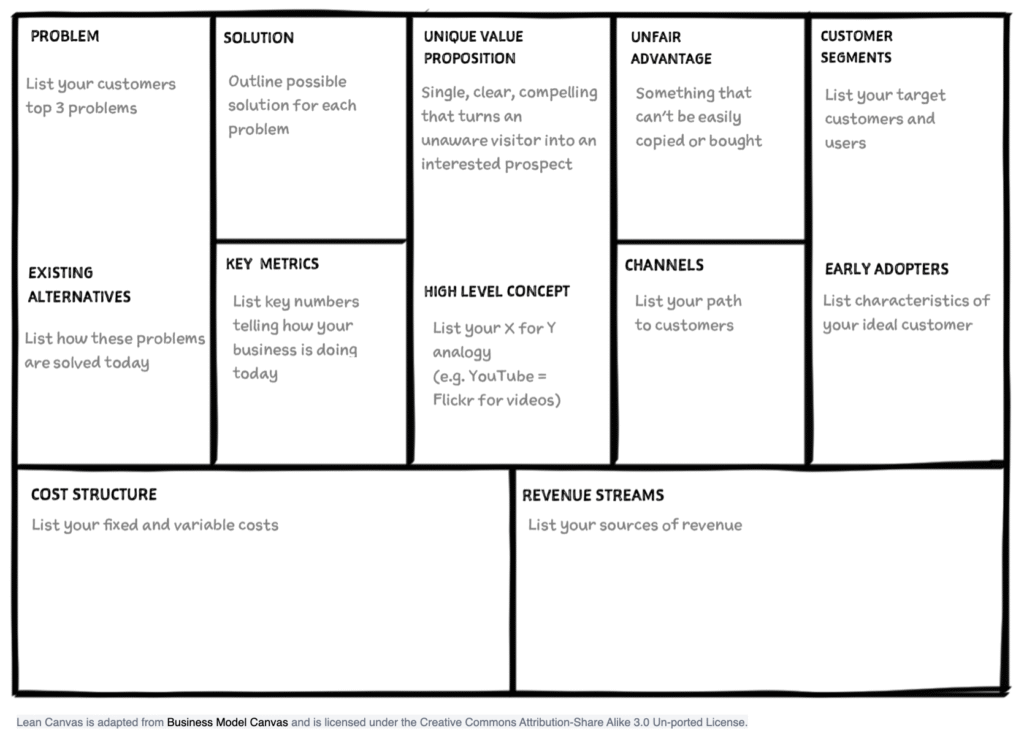
A practical tool for this is Ash Maurya’s Lean Canvas, a one-page business plan adapted from the Lean Startup methodology. It helps startups and SMEs clarify their strategy, validate assumptions, and avoid wasting time or money on the wrong ideas.
The Lean Canvas: Nine Key Blocks
- Problem: What specific pain points are you solving?
- Customer Segments: Who experiences these problems?
- Unique Value Proposition: What makes your solution compelling?
- Solution: How will you solve it?
- Channels: How will you reach your customers?
- Revenue Streams: How will you make money?
- Cost Structure: What are your main costs?
- Key Metrics: Which numbers indicate success?
- Unfair Advantage: What’s hard for others to copy?
By clarifying these nine areas, SMEs can focus on real customer value, validate their model early, and set measurable growth benchmarks. URL
How SMEs Can Use the Lean Canvas
For small and medium-sized businesses, the Lean Canvas acts as a reality check and a risk filter before committing significant time or money. It helps you ask the right questions early:
- Are we solving a problem people truly care about?
- Do we understand who our ideal customers are?
- Can we test our assumptions quickly and with minimal cost?
💡 Example:
Imagine you run a small fitness studio and are considering launching an online training program. Instead of building the full platform upfront, the Lean Canvas helps you identify the biggest risks:
- Is there enough demand for online classes?
- Who is willing to pay for them?
- How can we reach these customers effectively?
You might validate your idea first by running a few paid workshops, offering pre-sale memberships, or testing different marketing channels.
Three Key Questions to Guide Your Growth
As we wrap up this introduction to Growth Hacking and Lean Analytics, here are three essential questions every small business or startup should ask before moving forward:
- Have I identified a problem worth solving?
- Is the solution I’m proposing the right one?
- Do I truly want to solve this problem—or should I pivot and explore something else?
These questions help you focus on what really matters and set the stage for the next step: defining your North Star Metric, designing growth experiments, and measuring success effectively.
In short, growth hacking isn’t just a buzzword—it’s a smarter way of thinking about business growth. Combined with the clarity of Lean Analytics, it gives small businesses the ability to grow faster, adapt quickly, and stay relevant in a constantly changing market.