
How a Website Can Become Your Best Salesperson — And Your Most Powerful Growth Tool

In this article, I’ll break down why your website should be at the center of your growth strategy — and how it can help you win more customers, save time, and scale faster.

Table of Contents

Intro — Your Website Is Your Best Salesperson

Imagine you hire a salesperson who works 24/7, never takes a day off, greets customers politely, answers their questions instantly, and shows your best products in the best light. That’s exactly what a well-built website does — if you treat it right.

Yet, many SMEs treat their website as an online brochure they built years ago and forgot about. In today’s digital-first market, that’s like locking your store door during business hours.

1. Your Website Is Your Digital Headquarters

Your website isn’t just an online brochure — it’s the headquarters where all of your marketing efforts converge. Social media, ads, SEO, and partnerships are like roads leading visitors to your HQ — but only when they arrive on your website do you truly own the relationship, the data, and the experience. Social media, ads and third-party platforms are important for visibility, but you don’t own them — algorithms change, ad costs rise, and platforms can disappear. Your website, on the other hand, is real digital estate.

That’s why having your own site allows you to:

  • Control the experience — You decide the message, visuals, and customer journey.
  • Stay accessible 24/7 — Customers can explore, compare, and contact you anytime.
  • Build trust — A professional and frequently updated site signals legitimacy and reliability.
  • Expand your reach — A website bridges the gap between local and global markets, offering opportunities once only available to large corporations.

Allan Dib’s The 1-Page Marketing Plan reminds business owners that every prospect should move through three phases: 

  • Prospects (Before) – people who don’t know you yet and need awareness; 
  • Leads (During) – those who’ve shown interest and need nurturing;  
  • Customers (After) – buyers you now build loyalty and advocacy with. The danger of relying only on social media is you don’t own this relationship — the platform does.

So instead, funnel traffic into your own assets — your website, email list or CRM — where you can:

  • Track visitor behaviour with analytics tools
  • Capture leads via forms or newsletter opt-ins
  • Retarget visitors with ads
  • Move them through the “Before → During → After” journey

In short: social media only rents you attention — your website lets you own it.

2. Social Media Is a Rented Space, Your Website Is Home

Having a Facebook, Instagram, or LinkedIn page is like renting a booth at a busy marketplace. It’s great for exposure, but you’re still on someone else’s property. They decide the rules, they own the customer list, and they can move your booth to the corner without telling you.

Why relying on social media alone can hold your business back:

  • You don’t control the rules — Platforms decide how (or if) your content is shown, and every page looks the same.
  • The platform controls the traffic — You can’t fully track visitors or remarket to them without your own site.
  • Limited functionality — Social profiles can’t always integrate booking, e-commerce, or in-depth analytics. 

Bottom line: Social media should be your handshake, not your headquarters. Your website is where the real relationship starts.

3. First Impressions Matter — And They Happen in 3 Seconds

It takes users only 3–5 seconds to decide if they’ll stay on your website. That means your homepage needs to:

  • Load fast
  • Be mobile-friendly
  • Clearly say who you are, what you offer, and why you’re different
  • Have a clear next step (e.g., “Book a Call,” “Shop Now”)

A modern, easy-to-use site often makes the difference between gaining a customer or losing them to a competitor.

4. Your Website Can Work Like a Sales Machine

When done right, your site isn’t just “informational” — it’s a conversion engine. Here’s how:

  • Lead capture forms turn visitors into prospects.
  • Automated booking saves hours of scheduling.
  • E-commerce lets customers buy anytime.
  • Chatbots or forms answer FAQs instantly.

For example, a small café that added online ordering to their site. Within 3 months, 35% of their orders came in online without a single extra phone call to staff.

But making your site work like a sales machine isn’t just about features — it’s about psychology. That’s where  Darius Contractor’s Psych Framework comes in.

The Psych Framework: Mapping Motivation to Maximize Conversions
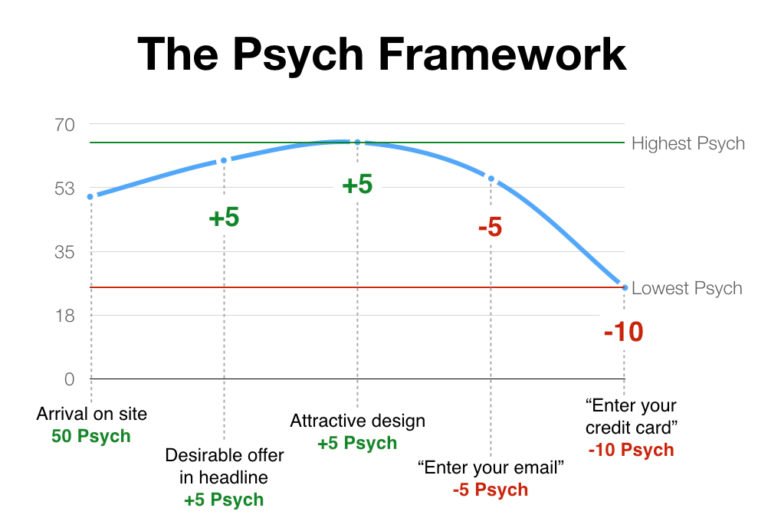
The Psych Framework graph

Every UX interaction increases or decreases Psych, the unit of measure for motivation to complete an action. (Source: URL)

Think of your customer’s motivation like a battery. Every interaction with your website either charges it (+Psych) or drains it (–Psych).

The Psych Framework, created by Darius Contractor, maps these changes so you can pinpoint exactly where energy is gained or lost:

  • Starting Psych — Every visitor arrives with a certain motivation level. Someone from a targeted ad may start high; a casual browser may start lower.
  • +Psych Moments — Professional visuals, persuasive copy, quick load times, and glowing testimonials give emotional boosts.
  • –Psych Frictions — Confusing navigation, too many form fields, or unclear calls-to-action drain motivation quickly.
  • Conversion Point — The goal is to keep Psych above zero by the time they hit your call-to-action — whether it’s booking a call, buying a product, or signing up.

When you understand the peaks and dips in your site’s Psych curve, you can make precise, high-impact changes that boost motivation at critical points and remove friction where it matters most — turning your site into a 24/7 sales machine.

That is why continuously validating adjustments with A/B Testing is important. Use A/B testing to measure the impact of improvements on the Psych motivation curve, iterating until motivation steadily increases and conversion rates improve. We’ll share more insights on A/B testing and how to leverage it effectively in our next blog post.

Imagine one day, David was casually browsing a website and saw your website advertisement. At that moment, he received a WhatsApp message from his wife, so he quickly went to reply on WhatsApp. A few days later, David saw the same advertisement on another website. Although he didn’t remember it very clearly, he felt the ad was somewhat familiar. Since he had some free time, he thought, “It doesn’t cost anything, so why not give it a try?” and clicked the ad to enter your website.

After entering the website, David browsed your site for the first time. At this moment, as a potential user, he was at a very special point. On one hand, he had already decided to try the website’s features and was motivated to figure out how to use it and see if it could fulfill the promises made in the ad. On the other hand, he had gone through the process of seeing the ad, making the decision, and entering the site, which consumed some of his emotional energy, thoughts, and time, so his “energy bar” had already dropped.

Assuming David’s excitement index was 100 when he first clicked the ad, it dropped to 80 after browsing the site, reading reviews, and waiting for pages to load. Finally, the webpage loaded completely, but when he opened the site, he saw a page filled with dense text and felt overwhelmed, causing the excitement index to plummet to 65. Still, David clicked the “Register” button. Fortunately, the registration form was well designed—only two fields were required: email and password, and the password rules were clearly stated. David successfully completed the form, and his excitement only dropped slightly to 60.

Next, a popup appeared asking him to allow push notifications. David thought, “I haven’t figured out how to use this site yet,” and feeling a bit annoyed, quickly clicked “Maybe Later.” His excitement index dropped to 40. Just as he put that aside, another popup asked him to sync his contacts. David muttered to himself, “When will this end?” and again clicked “Maybe Later.” His excitement index fell further to 20.

Finally, he entered the main interface of the website, faced with a blank screen and no guidance. David felt a wave of despair — “How am I supposed to use this?” His excitement index instantly dropped to 0. At that moment, a WhatsApp notification from his wife popped up. David closed your website and went to chat with his wife, as if nothing had happened.

For your website, the worst outcome—beyond users doing nothing—is spending money on ads but failing to retain even one user or make any conversions.

5. It’s Your Best Marketing Asset

Your website supports every other marketing channel:

  • Ads send traffic to your landing pages.
  • Social media links to your blog or offers.
  • Email drives clicks to product or service pages.

Without a strong site, you’re sending potential customers into a leaky bucket.

6. Data-Driven Growth

Your website is also a data goldmine. With analytics, you can see:

  • Which pages people visit most
  • How long they stay
  • What they click before buying or leaving

These insights let you make targeted, measurable changes that directly improve sales.

7. The “Quick Win” Mindset

Updating your site doesn’t have to be expensive or slow. Small tweaks can make a big impact:

  • Add a clear call-to-action on every page.
  • Use real, high-quality photos.
  • Simplify navigation.
  • Highlight customer reviews.

With A/B testing, I can help you see measurable results within 30 days

Conclusion: Your Website Should Pay for Itself

If your site isn’t bringing you leads, sales, or brand authority, it’s not doing its job. In today’s market, your website isn’t optional — it’s your most important growth tool.

In the next article, I’ll cover one of the most powerful (and often overlooked) ways to boost your site’s performance: A/B testing.

Don’t want to miss the latest insights?

No spam. Once per month.

Get in Touch!

Reach out if you’ve ever asked yourself:
Where can I reach you?
Tell me more about you and your business

Is Your Website Costing Your Customers?

We’ll analyze your website’s performance, design, and user experience and send you a personalized report.

Tell me about yourself
Q1: What is your goal for the next 30–60 days?
Q2: Do you currently use any analytics tools (e.g. GA4,)?
Q3: Do you have edit access to your website / developer support available?
Q4: What platform is your site built on? (WordPress / Wix / Shopify / custom)?
Q5: Have you made any changes of your website in the past 3–6 months?