
Why Empathy Is the Foundation of Sustainable Growth
When founders think about growth, the first instinct is often to search for tactics—paid ads, funnel tweaks, viral loops, A/B testing. But Sean Ellis, the originator of the term “growth hacking,” makes one point absolutely clear:
👉 No growth tactic works unless your product is a must-have.
A must-have product grows almost irresistibly: users come back, tell others, and integrate it into their lives. A nice-to-have requires constant marketing, constant nudging, and still suffers from churn.
This makes the “must-have” question the most important early question in any business:
Does my product truly solve a painful problem and deliver a powerful Aha moment?
To answer this, we turn to two key frameworks:
From 《Hacking Growth》 the Aha moment, and from 《Lean Analytics》 the Empathy stage and the process to validate real problems.
1. The Aha Moment: The Birth of a Must-Have Product
Every must-have product has a defining moment of clarity—the instant when the user understands:
- what the product really does
- why they absolutely need it
- what benefits it brings to their life or workflow
This is the Aha moment.
It’s not a feature. It’s not a funnel step. It’s not even a metric. It’s a psychological shift inside the user. Examples help illustrate this:
- Slack: when a new team member sends a message and gets an immediate reply—experiencing team alignment in real time.
- Airbnb: the moment a traveler books a unique home and realizes travel can feel local, authentic, and inexpensive.
- Dropbox: when a user installs it on two devices and sees files syncing instantly.
The Aha moment is the core of the product’s value. Growth teams then work backward to optimize activation so users reach this moment faster and more reliably.
Why Aha Moments Matter for Growth
- They correlate strongly with long-term retention
- They define what your MVP must include
- They guide product onboarding
- They become the “north star” of what truly matters
If users don’t reach an Aha moment, no acquisition strategy will fix retention. If they reach it quickly and consistently, growth tactics start to compound. But to create a strong Aha moment, you must first understand the real pain users experience. This is where Lean Analytics becomes powerful.
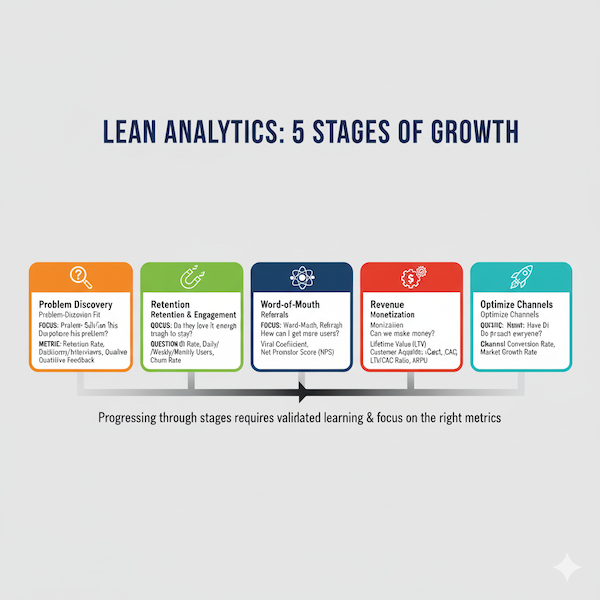
2. The Five Stages of Growth
Lean Analytics explains that every successful startup crosses five stages:
- Empathy – deeply understanding customers’ pain
- Stickiness – building a product people return to
- Virality – making usage spread naturally
- Revenue – proving people will pay
- Scale – growing efficiently with data and systems
The authors emphasize:
👉 If you get Empathy wrong, all the other stages crumble.
Empathy is the mother of retention. Retention unlocks virality. Virality speeds revenue. Revenue supports scale. Everything begins with a product that solves a problem people genuinely feel.
3. Stage One: Empathy — The True Foundation of a Must-Have Product
A. Discovering a Problem Worth Solving
This is not done through surveys or assumptions.It begins with conversations—listening, probing, understanding. You are looking for answers to:
- What hurts?
- What frustrates them daily?
- What are they trying to achieve?
- Why does this matter emotionally?
If the problem is mild, episodic, or merely inconvenient, it won’t create a must-have product.
B. Validate That the Problem Is Deep and Frequent
You want problems that:
- Occur often
- Interrupt important workflows
- Generate emotional frustration
- Users attempt to solve on their own
Users who already hack together workarounds are signaling:
👉 “This problem is painful enough that I’ll spend effort fixing it.”
That’s a strong indicator of a must-have opportunity.
4. Dig Deeper: Asking “Why?” Three Times
Users rarely articulate their real pain in the first sentence. Lean Analytics recommends a simple technique: Ask “Why?” three times.
Example: User: “Our team wastes time coordinating tasks.”
- Why? → “We use too many tools.”
- Why? → “We don’t know which tool to check first.”
- Why? → “We don’t have a shared source of truth.”
Only at the third “why” does the real problem emerge: lack of a shared source of truth. This insight changes your MVP entirely.
5. Divergent vs. Convergent Interviews
Lean Analytics recommends two phases:
Divergent Interviews (explore widely)
- listen without assumptions
- gather stories, frustrations, messy details
- look for emotional cues and repeated patterns
Convergent Interviews (validate patterns)
- confirm recurring pains
- test hypotheses
- quantify severity and frequency
This ensures you don’t build too early or lock onto weak signals.
6. Scoring the Problem: Is It Painful Enough?
You can score problems by:
- Severity – How much does it hurt?
- Frequency – How often does it occur?
- Workaround cost – Time, frustration, money spent fixing it
- Emotional intensity – Anger, embarrassment, anxiety, stress
High-scoring problems are the ones that lead to must-have products;Low-scoring problems lead to nice-to-have apps that struggle to retain users.
7. Understanding Current Workarounds
A key insight from Lean Analytics:
If people are not solving the problem on their own, it’s not painful enough.
Users always find a patch: spreadsheets, manual steps, emails, notes. Your product must be significantly better—not 10% better but 10x better—to make them switch. This is another test of must-have status.
8. Validating the Solution Before Building Anything
Before building, show users:
- sketches
- prototypes
- Figma flows
- landing pages
- concierge services*
Your goal is to verify:
- Does this proposed solution relieve the pain?
- Do users light up emotionally?
- Do they ask, “When can I use this?”
- Are they willing to sign up early?
If not, the solution is not compelling enough.
What does "concierge services" mean in product development?
✔ What “Concierge Service” Means in New Product Development
It refers to:
Using a manual, human-delivered process to simulate the core value of the future product, allowing users to experience the “solution” even though the feature isn’t automated or fully built yet.
In other words: You deliver the service by hand, but make the user feel like they’re using the real product.
✔ Why This Is Done
Before writing any code, you want to quickly validate whether users are truly willing to pay for the solution.
You’re testing:
- Is the pain point strong enough?
- Do users genuinely need this service?
- Are they willing to pay?
- Is this solution worth building?
✔ Classic Examples
🌟 1. Airbnb (early days)
The founders did not build the platform first.
They took photos themselves and manually matched guests with hosts.
A fully manual concierge approach to validate:
“Will people actually stay in someone else’s home?”
🌟 2. Zappos (online shoe store)
The founder didn’t build systems or buy inventory initially.
When someone ordered a shoe, he went to a physical store to buy it, then shipped it manually.
The goal was to test:
“Will people buy shoes online?”
🌟 3. Stitch Fix
Stylists manually selected clothing instead of relying on algorithms.
This validated:
“Do customers actually want personalized fashion recommendations?”
✔ One-Sentence Summary
Concierge service = Manually delivering the core value of the future product to confirm real user demand before investing in development.
9. Designing the MVP That Delivers the Aha Moment
A proper MVP should not be a small version of the full product. It should be a focused delivery of the core value.
Your MVP must deliver:
- the essential workflow
- the core benefit
- the clear Aha moment
If users cannot reach the Aha moment inside the MVP, then the MVP is not ready.
10. Measuring the MVP: Does This Product Deserve to Exist?
Track only a few critical things:
- Did users hit the Aha moment?
- Did they return without reminders?
- Did they try to use it in meaningful ways?
- Did they recommend it?
Your MVP’s job is not to scale but to answer one question:
👉 Is this product a must-have for a significant group of people?
If yes, then you’re ready for the next stages: Stickiness → Virality → Revenue → Scale. If not, return to Empathy.
Conclusion: Empathy → Aha → Must-Have → Growth
Growth hacking is not about tactics. It is about building a product people cannot live without.
A must-have product emerges when:
- you deeply understand the user’s pain (Empathy)
- you validate that the pain is real and urgent
- your solution is dramatically better than workarounds
- your MVP delivers a clear, powerful Aha moment
- users return naturally and tell others
This makes all growth tactics exponentially more effective. In other words:
👉 Empathy is not just the first stage of growth — it is the foundation that every stage is built upon.