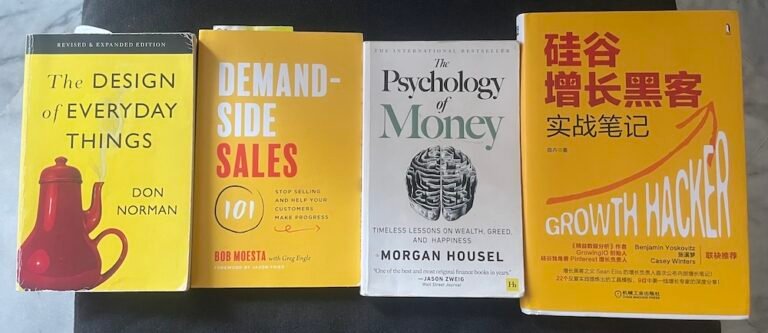
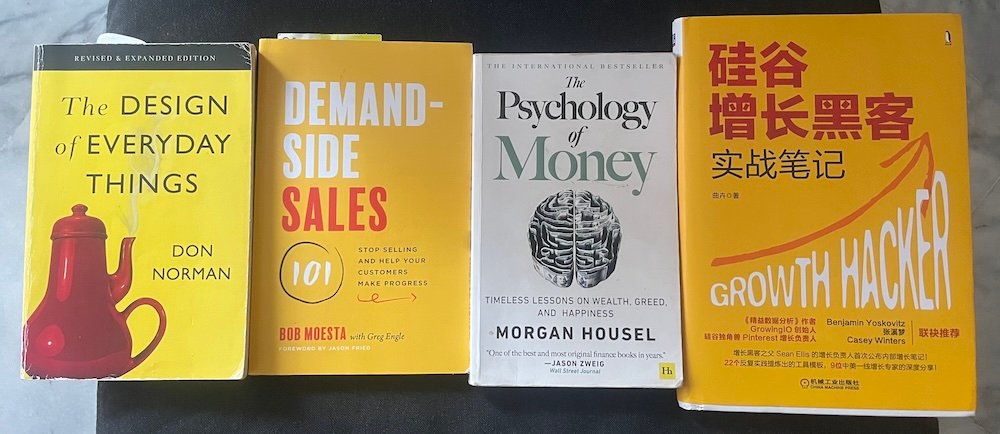
Before the year ends, I wanted to share some thoughts and reflections on a few books I’ve read the past two years that taught me a lot and were immensely rewarding. This is also a way to look back on 2025 while catching up with friends. A good book is often the result of an author condensing years of experience, mistakes, and reflections, and reading remains one of the most cost-effective and efficient ways to learn. The following four books have had a profound impact on my thinking and my practice in new work fields over the past two years. Although the topics differ greatly, they share a common thread: all are based on frameworks rooted in psychology, human behavior, and empathy, whether exploring financial concepts, understanding deep customer needs to inform sales, designing products that feel intuitive, or using scientific experiments to drive growth. These perspectives and learning frameworks were largely absent during my school years. (Oops, I just gave away my age), so they’ve deeply influenced how I think and act in new professional areas. I hope my sharing can inspire others as well.
The Psychology of Money — Morgan Housel
Morgan Housel’s The Psychology of Money is not a book about how to get rich quickly. Rather, it explores how people actually relate to money and why that matters more than financial formulas.
The central insight is that financial outcomes are driven more by behavior than by knowledge. Our choices about money are influenced by emotions, fear, luck, ego, and personal experiences. Even when two people have the same information, they can make completely opposite decisions, and both believe they are rational.
What struck me most is that everyone’s understanding of money is shaped by their own life experience. What feels “safe” or “risky” depends on the era you grew up in, the financial events you’ve lived through, and the success and failure stories you’ve seen. This explains why many financial debates never convince anyone because we’re each arguing from different psychological baselines.
The book also redefines “success.” Housel argues that true wealth is not measured by what you can buy, but by the freedom to control your time. Knowing what is “enough” is more important than endlessly chasing higher returns. Many people fail financially not because their goals are too small, but because they never know when to stop.
Housel repeatedly emphasizes the power of compounding and patience. Most long-term financial success comes NOT from brilliance or high-risk maneuvers, but from avoiding catastrophic mistakes and staying in the game consistently. Time, consistency, and humility often outperform skill, this is also why Warren Buffett has been so successful.
Reading The Psychology of Money has greatly influenced not only my approach to personal finance, but also my understanding of wealth as the freedom to control one’s time, which is especially inspiring as I pursue a new career path. The book doesn’t give step-by-step investment strategies, but it provides a much clearer perspective on money, and that clarity is itself a form of long-term value.
Morgan Housel, a former columnist for The Wall Street Journal and two-time winner of the Best Business News Award, is also a partner at Collaborative Fund. His experience allows him to observe patterns in history while seeing wealth creation firsthand in Silicon Valley. His writing is influenced by psychology, history, and sociology. Housel emphasizes “Financial success is not about intelligence, but about behavior—emotions, ego, patience.” This perspective helped The Psychology of Money quickly become a global bestseller.
Morgan Housel, a former columnist for The Wall Street Journal and two-time winner of the Best Business News Award, is also a partner at Collaborative Fund. His experience allows him to observe patterns in history while seeing wealth creation firsthand in Silicon Valley. His writing is influenced by psychology, history, and sociology. Housel emphasizes “Financial success is not about intelligence, but about behavior—emotions, ego, patience.” This perspective helped The Psychology of Money quickly become a global bestseller.
The Design of Everyday Things — Don Norman
Don Norman’s The Design of Everyday Things changed the way I perceive everyday frustrations. Doors that won’t open, confusing switches, or products that feel awkward to use, more often than not, the problem lies not with the user, but with the design itself.
The core message of the book is that good design should be intuitive, understandable, and forgiving of mistakes. When a product is well-designed, people don’t need a manual; the object itself communicates how to use it through cues. Elements like affordances, signifiers, and feedback are essential in helping users understand the consequences of their actions.
A key mindset shift the book inspired is to stop blaming the user. Instead of asking, “Why did the user make a mistake?”, Norman encourages asking, “Why did the system allow the mistake to happen?” Human error is inevitable, and good design anticipates mistakes, reduces their impact, and helps users achieve their goals smoothly. I recall a story from my friend Cathy: when her colleague traveled to Germany, he tried to print his boarding pass at an airport kiosk but couldn’t make it work. When he asked the staff for help, the response was, “The machine can’t make mistakes; you must be doing something wrong.” 😂 This real-life example perfectly illustrates Norman’s point.
Norman also highlights the gap between how designers think and how users actually behave. People don’t act entirely rationally, instead they rely on habits, intuition, and context. Designs that ignore human psychology, memory limitations, and attention allocation inevitably create friction and frustration.
This book has influenced not only my understanding of product design, but also my broader approach to problem-solving: clear mapping, immediate feedback, and simplified processes are principles that apply beyond interfaces: to services, communication, and even how we organize our work.
After reading it, I began noticing design everywhere in my daily life: I became more patient with people and more critical of the environments I interact with. The Design of Everyday Things didn’t just make me a better user experience designer, it made me more aware that the invisible design around us quietly shapes our everyday experiences.
Don Norman was the first person to put “User Experience Architect” on a business card. In the 1990s, he served as Vice President of Advanced Technology at Apple, establishing the foundation for Apple products’ enduring focus on intuitive operation (The buttonless iPhone we use today is the result of his vision). He holds an electrical engineering degree from MIT and a PhD in psychology from the University of Pennsylvania. This combination of technology and psychology allows him to analyze why we continually encounter frustrating designs in everyday life. Norman is also an Honorary Professor at UC San Diego and co-founder of the Nielsen Norman Group, helping countless Fortune 500 companies optimize their product experiences.
Demand-Side Sales — Bob Moesta & Greg Engle
Demand-Side Sales challenged many of my assumptions about sales and marketing. Bob Moesta and Greg Engle present a key insight: real growth doesn’t come from better sales techniques, but from deeply understanding the “progress” a customer is trying to make.
The book is based on the Jobs to Be Done framework. Customers don’t buy products for their features; they “hire” a solution to help them move forward in a specific situation. The focus isn’t on who the customer is, but on what situation they are in and what outcome they want to achieve.
What resonated with me most is the shift from persuasion to diagnosis. Instead of asking, “How do I convince them?”, demand-side sales asks, “Why would this choice make sense for them right now?”
The book highlights four forces that influence decisions: the pain of the current situation (push), the attraction of a desired future (pull), the inertia of staying the same, and anxieties about change. When you truly understand these psychological forces and conflicts, sales stops being about pressure and becomes a process of helping the other person clarify their current situation.
The book also redefines rejection. Often, a deal doesn’t happen not because the solution is bad, but because the timing isn’t right or the customer isn’t ready to change. Understanding this reduces frustration and self-doubt.
More importantly, this demand-side perspective applies beyond sales. It can inform product design, marketing strategy, and even personal decision-making. When we understand the real “job” behind a choice, we stop optimizing for surface metrics and start solving meaningful problems.
Demand-Side Sales reminded me that growth isn’t about pushing harder, it’s about truly standing on the other side of the table and seeing the challenges they are facing.
Bob Moesta is a legendary innovation consultant in Silicon Valley and co-creator of the Jobs-to-Be-Done theory. He collaborated for many years with disruptive innovation master Clayton Christensen. With a background in engineering and psychology, he has contributed to the development of over 3,500 products. Along with his partner Greg Engle, he co-founded Re-Wired Consulting, which aims to redefine sales and product development through the lens of human behavior.
Silicon Valley Growth Hacker Handbook — Hui Qu
Silicon Valley Growth Hacker Handbook is not a step-by-step toolbook for quick viral growth. Rather, it is a practical guide that repeatedly emphasizes: growth must be built on product value and genuine user needs. Drawing on frontline experience in Silicon Valley, Hui Qu deconstructs many common misconceptions about “growth hacking.”
One of the most important insights in the book is that growth is not solely the responsibility of marketing, but the result of the combined efforts of product, data, and user experience. A product that isn’t needed cannot achieve sustainable growth, no matter how much traffic or marketing skill is applied. This perfectly echoes Bob Moesta’s Jobs-to-Be-Done theory.
The book emphasizes data-driven decision-making but does not blindly worship data. Hui Qu stresses that metrics are meant to help understand user behavior, not serve as a tool for performance pressure. What truly matters is identifying the critical points that affect user retention and perceived value, and continuously running rapid experiments to validate assumptions.
Another point that left a strong impression on me is the book’s approach to trial and error. Growth is not a single magic trick, but a system of small, fast steps, quick failures, and rapid adjustments. The most successful teams are not necessarily the smartest—they are the ones that learn the fastest.
The book also reminds readers that growth models must consider the user’s entire journey, from first contact, first realization of value, retention, to referral. Optimizing only one stage while ignoring the holistic experience rarely leads to truly sustainable growth.
After reading, my understanding of “growth” became clearer and more grounded. Growth is not a miracle; it is the result of patience, discipline, and continuous experimentation with products and users. The book also provides actionable frameworks and methodologies that can be applied in practice.
Hui Qu is a highly influential practitioner in the growth field in Silicon Valley. She previously served as Vice President of Growth at Acorns, a startup recognized by Fortune as one of the most promising companies. During her tenure, she led her team in applying precise growth models and A/B testing to achieve remarkable user retention and scale.
Before that, she worked at Intel and held key product and growth roles at multiple Silicon Valley startups. Hui Qu combines deep expertise in data analysis with cross-functional leadership skills. Silicon Valley Growth Hacker Handbook distills her years of frontline experience into a replicable scientific approach to growth, transforming it from what many see as a “mystery” into a systematic methodology. She remains highly active in the Silicon Valley growth community today.